
PVC roof covers for grandstands: how they are made and what details to send
A covered grandstand protects spectators from sun and rain, and the part everyone sees is its roof: a large PVC membrane tensioned over a metal structure, common at racing circuits, sports events, concerts and fairs.
This guide explains how that roof cover is made, which fabric to choose, which fire classification venues and local councils usually ask for, and what details to send for a quote. At Plastold we have been making made-to-measure PVC covers in our factory in Málaga since 1998; the design and structural calculation of the frame always belong to its manufacturer.
Need it made to measure? Request a free quote · WhatsApp +34 670 087 956 · Free sample book for professionals
What a grandstand cover is and who makes each part
A covered grandstand has three parts: the seating deck; the roof structure, with frames and beams in aluminium or steel; and the membrane, the PVC fabric that closes the roof. Rear or side panels are sometimes added against wind and rain.
Each part has its own owner. The structure supplier defines wind and snow loads, ballast or anchoring and the roof geometry, and provides the calculation. The fabric manufacturer makes the membrane to the exact size of that structure, with the finishes its system needs.
Which fabric to choose: white opaque or translucent, 650 or 850 g/m²
The usual membrane is a polyester fabric coated with PVC. Grandstands normally use white: it reflects much of the sun, so the space underneath stays cooler than with dark colours.
White opaque: gives full shade; the usual choice when protecting the audience from the sun comes first.
White translucent: lets diffused light through, so the stand is brighter, in exchange for slightly less shade.
If you are unsure, our guide to opaque, translucent or transparent PVC fabric will help.
We work with 650 and 850 g/m² fabric: the first is lighter and easier to handle in large panels; the second is thicker and stronger for intensive use and frequent assembly. Our house fabrics are OPTEX (white, 850 g/m²) and COTEX (white, 680 g/m²). See the options in PVC fabric for tents and covers or compare them in the 650 or 850 g/m² guide; we also supply the fabric in PVC fabric rolls.
Fire classification: T2 under UNE-EN 15619
A grandstand holds an audience, so the venue, the organiser or the local council usually ask for the fabric's fire reaction documents before approving the installation.
Plastold's OPTEX and COTEX fabrics are classified T2 under the European standard UNE-EN 15619, tested to EN 14115 by AITEX (reports 2024AN2176 and 2024AN2177, issued on 2 October 2024). You will find the details on the fire-retardant PVC fabric page and, if the installation is in another country, in our guide to fire reaction certificates in Europe.
A tip: ask for the documents of the specific fabric used for your cover, not those of a generic range, and keep a copy in the event file.
Panels made to the structure's bays, with keder
A grandstand roof is not a single sheet. It is made in panels, one per bay, the space between two frames. The frame spacing depends on the system; on many aluminium structures it is 5 m.
Each panel has keder on both long sides: a PVC cord welded to the edge that slides into the channel of the aluminium profiles, so the panel can be pulled along until it covers the bay. The keder diameter must match the channel; if you do not know it, we explain what a keder is and how to identify the one on your structure.
The panel length follows the roof rafter, from eave to ridge (or eave to eave on a mono-pitch roof), plus the end finishes. Because fabric comes in rolls of limited width, each panel is made of several widths welded, not sewn, so the seams are watertight, just like our replacement tent covers.

Tensioning, joints and water run-off
A slack membrane performs badly: in wind it flaps and wears at rubbing points, and in rain it forms water pockets that load the structure. That is why each panel is made to a size that allows proper tensioning with the structure's system: tension tubes or bars at the ends, ratchets or straps.
Between panels, the aluminium profile itself acts as the joint; at eaves and ends, valances or flaps are added wherever a finish needs covering or water must be kept out.
Water must run off to the back of the stand or into a gutter, never onto the audience. The pitch and drainage are part of the structure's design; the fabric is adapted to them.
A recent example: covered grandstands in Madrid
For the Formula 1 Spanish Grand Prix, held in Madrid in September 2026, Plastold made in its Málaga factory the white PVC roofs of covered spectator grandstands, which the tent installation company set up at the circuit. The grandstand structures were supplied by another company: our job was the fabric. For the tents of the same installation we also made side walls and gable ends, explained in our guide to side walls and gable ends for 10 m tents.

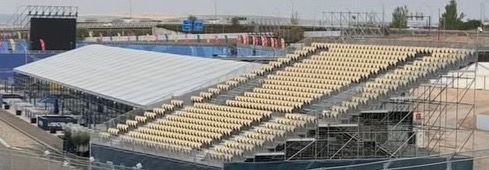
Photos: installation company, published on its social media.
Plastold (Boreolam S.L.U.) is not a sponsor, partner or official supplier of Formula 1, the Grand Prix or the circuit, and this content is not approved or endorsed by Formula 1, IFEMA MADRID or MADRING. FORMULA 1 and F1 are trademarks of Formula One Licensing B.V.
What details to send for a quote
Drawings of the structure or, if you do not have them, overall photos and close-ups of the profiles.
Bay width: the distance between frame centres.
Length of the roof rafter, from eave to ridge or from eave to eave.
Number of bays.
Colour and type of fabric: white opaque, white translucent or other.
Keder diameter or profile model, and tensioning system.
Whether you need rear or side panels.
The date you need the material by and the delivery address.
If you are not sure how to take a measurement, follow our step-by-step guide to measuring your tent: the approach is the same.
Frequently asked questions
Does Plastold also make the grandstand structure?
No. We make the fabric: made-to-measure PVC roofs, enclosures, walls and gable ends for structures of any brand. The structure, its calculation and its assembly are the responsibility of the structure supplier and the company that installs it.
What fire documentation does the fabric have?
Our OPTEX and COTEX fabrics are classified T2 under the European standard UNE-EN 15619, tested to EN 14115 by AITEX. We provide those documents for the event file.
Can the covers be reused?
Yes, on structures with the same bays and the same profile. To make them last, take them down clean and dry, store them neatly rolled or folded, and check the keder and welds before each installation.
How long do manufacturing and shipping take?
Manufacturing time depends on the volume and is confirmed with each quote. Once the goods leave the factory, transport across Europe usually takes about one week.
If you have a grandstand or a stand to cover, send us the details and we will prepare a fabric proposal.
Real project: PVC grandstand roofs and 288 tent side walls, made in Málaga for a major motorsport event in Madrid. See the project
Need it made to measure? Request a free quote · WhatsApp +34 670 087 956 · Free sample book for professionals


Comments